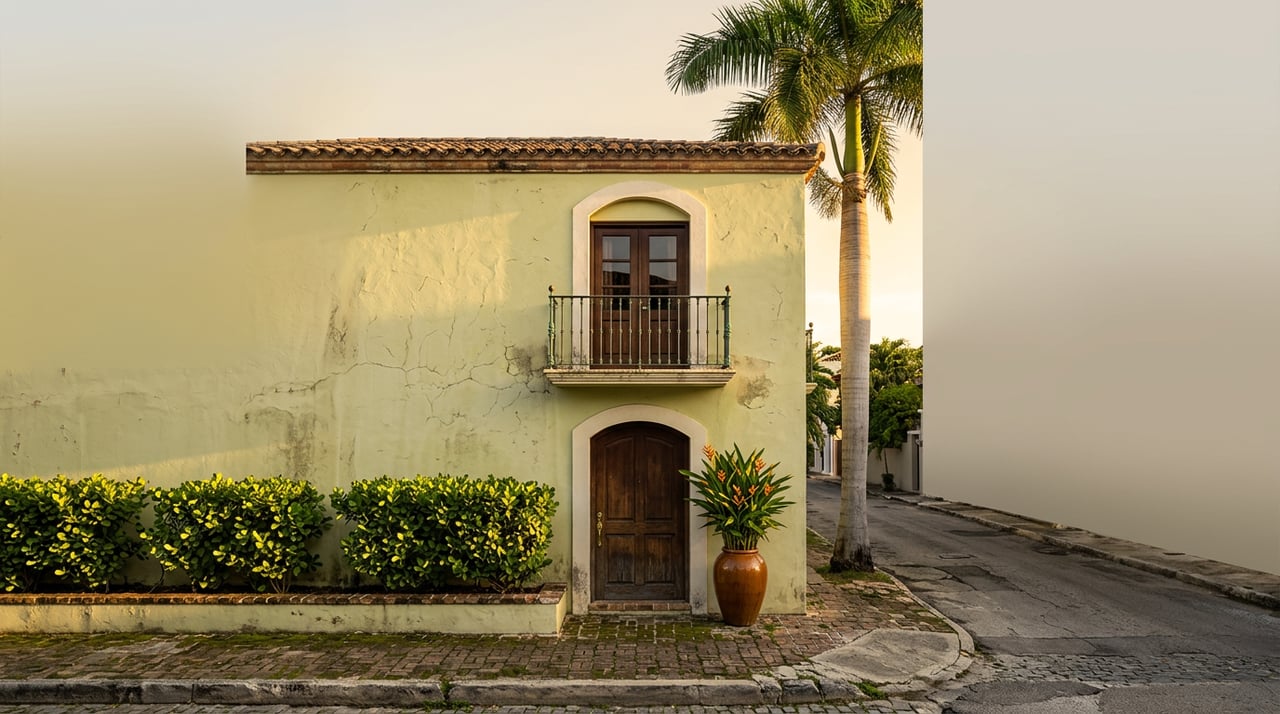
Start at the corner where Calle Loíza meets De Diego Avenue and walk east. Within ten minutes you will pass a vintage shop, a bakery with a molecular pastry case, a corner house with an arched balcony that once belonged to one of Puerto Rico's most famous soneros, and a sushi counter that shares a block with a juice bar that also sells clothes. Ask five residents where "La Loíza" actually ends and you will get five different answers, because the street has never agreed with itself about where it stops, what it is, or who it belongs to.
That confusion is not new marketing gloss. It is the oldest fact about the street.
A Line the City Drew Without a Map
Long before Calle Loíza became known for brunch and boutiques, it functioned as an actual boundary. For much of the twentieth century, the street served as the informal frontier between the traditional, working-class barrios of Machuchal and Barrio Obrero on one side, and the newer, wealthier development on the other that would eventually become Ocean Park and Condado. People on either side knew which side they were on. The street itself was the marker.
That boundary hardened into something more physical in 1961, when the elevated Baldorioty de Castro expressway opened along what had been open blocks. Before the highway went in, streets like Taft, Aponte, and Diez de Andino ran continuously through the neighborhood, and Machuchal and the areas beyond had no fixed edge at all. The expressway sliced the barrio in a way the social geography already had, and traces of those older streets still exist as fragments on both sides of the highway today, according to a community history project run by the nonprofit La Calle Loíza Inc. That project has spent years collecting oral histories from residents who remember the street before the highway, and for a stretch of years it ran a monthly guided walk retracing that history one Saturday at a time, led by longtime neighbors rather than tour operators.
None of that history shows up on a menu or a storefront. But it explains why the same half mile can feel like two different neighborhoods depending on which block you're standing on.
Where the Street Officially Ends, and Why Nobody Treats It That Way
Here is a detail most people who eat on this street every week do not know: Calle Loíza, by name, only runs from that De Diego Avenue corner to Calle Júpiter. Past Júpiter, the road becomes Avenida Isla Verde, continuing on toward the airport corridor and the beach neighborhoods of Carolina. Locals call the whole run "La Loíza" regardless, folding the official Isla Verde stretch into the identity of the street that comes before it.
That casual disregard for the actual street sign says something true about how residents experience it. From Luis Muñoz Marín International Airport, you can reach one end of the corridor in ten to fifteen minutes, which means this stretch functions less like a single commercial strip and more like a connective hallway between the beach neighborhoods to the east and the Condado-facing blocks to the west. People don't experience Loíza as a destination. They experience it as the route.
The Block That Still Belongs to Ismael Rivera
Partway along the corridor sits a street now named for Ismael Rivera, the sonero known across Puerto Rico as El Sonero Mayor, though for most of the neighborhood's life it was known simply as Calle Calma. The house where Rivera grew up still stands there: a modest cement structure with an arched balcony and iron grillwork, the kind of typical cangrejera construction that once lined these blocks before renovation and new development changed most of the surrounding streets. It sits a few steps from some of the strip's busiest new restaurants, and it has not been folded into the commercial identity of the street the way so much else along Loíza has.
That contrast is worth noticing on purpose. A block that could easily have become another retail address instead stayed residential and quiet, holding onto a piece of the neighborhood's musical history while the restaurant economy built up around it on both sides.
What's Actually Open Along the Strip Right Now
The current mix of businesses along Calle Loíza reads like a direct answer to that old dividing line. Longstanding criollo institutions sit within a few storefronts of concepts that would not have existed here a decade ago.
- Bebo's Cafe, a mofongo institution rated 4.5 on Google with more than 8,500 reviews, still anchors one end of the strip with fried pork chops and avocado stuffed with crab.
- La Cueva del Mar covers the seafood side of the street in a laid-back, unfussy setting.
- Ana's Cafe runs breakfast through dinner with straightforward Criollo cooking.
- Café con Cé handles the coffee-and-pastry crowd, including a vegan guava cake that shows up regularly in local reviews.
- Panuchos brings Mexican dishes and margaritas into the mix.
- Ginga Japanese BBQ & Sushi, rated 4.7 on Google, gives the street its Japanese option.
- Kamoli blends juices and healthy plates with a small retail counter selling clothing and gifts.
- Vianda and Sabrina cover the elevated brunch end of the spectrum, the kind of spots visiting food writers gravitate toward.
- Café Tresbé, at 1765 Calle Loíza, and shops like Vice Versa and Sixne Concept Store round out the retail and café side, vintage clothing and concept goods sitting a few doors from decades-old lunch counters.
None of these businesses arrived because a developer decided the street should have them. They arrived one at a time, each one calculating the same math a longtime nightlife operator on the strip once laid out plainly: the location sits close enough to Ashford Avenue's foot traffic to benefit from it, without carrying Ashford Avenue's rents. That math is still working, which is part of why new concepts keep landing here even as the older institutions hold their ground.
One Day When the Two Sides Run as One Street
For most of the year, Calle Loíza functions the way it always has, as a string of separate blocks that happen to share a name. There is exactly one day when that stops being true.
The Calle Loíza Culinary Fest runs every year on the second weekend of November, and it closes the entire stretch between De Diego Avenue and Tapia Street to cars for a single day. Last year's edition landed on Sunday, November 16, 2025, running from around midday into the evening. More than one hundred restaurants set up pop-up kitchens along the closed street, three stages rotate through five or six musical acts each, and the day functions as the unofficial opening of the neighborhood's Christmas season.
For those few hours, the block near Vianda and Sabrina, the residential quiet around Ismael Rivera's old house, and the stretch approaching Ave Isla Verde all operate under the same program, the same music, the same crowd moving from one end to the other on foot. It is the one day a year when the street's oldest divide disappears entirely, even if only until the stages come down and the cars come back.
That is the real thing to understand about Calle Loíza before you decide what it is. It was never one street pretending to be many. It was many histories that happen to share one road, and once a year, for a single Sunday, they all agree to walk it together.
If you're getting to know Santurce and want a clearer read on how its different blocks actually function day to day, Gigi Realty PR works this corridor and the neighborhoods around it regularly. Reach out to request your personalized market valuation whenever you're ready to talk specifics.