If you're buying an Isla Verde condo to rent by the night, the key document isn't a municipal license. It's the building's reglamento, the bylaws attached to the master deed. Since January 6, 2026, you have a legal right to receive a copy within five business days. Act 13-2026 amended Article 13 of Puerto Rico's Condominium Act. The building's administrator now has to send the bylaws to a prospective buyer who asks, or to the broker handling the sale once the broker shows they represent it, within no more than 5 business days. The law took effect as soon as it was approved.
Most buyers treat the bylaws as closing paperwork. In Isla Verde, they answer the main question an investor has, which is whether the unit can earn money the way the spreadsheet assumes. The rest of this post explains why the answer sits in that document and not at City Hall.
The five-day request, in practice
Act 13 spells out who has to deliver the bylaws and what they must collect first. The building's managing agent is required to ask a requesting broker for a license number, photo ID, phone, mailing address and email. The law says the administrator doesn't have to hand the bylaws to any broker or third party who has no legitimate interest in a specific transaction. Along with the bylaws, the administrator must give their own contact information and the Board of Directors' contact information. If the building has no designated administrator, the duty falls to the board president, or to the secretary if there is no president.
The legislature's stated reason is short and practical. A buyer should know the rules that govern what could become their home before committing. The board contacts are also useful. They tell you who to ask about something the bylaws can't show you, which is whether an amendment is being discussed.
Why the bylaws hold the answer
Puerto Rico's Condominium Act, Ley 129-2020, defines a short-term lease as one under 90 consecutive days. According to the law's statement of purpose, those rentals can't be prohibited unless the master deed or the bylaws set a minimum lease term. Each building's Council of Owners can regulate how short-term rentals operate. The Council can also amend the master deed or bylaws at any time to establish, modify or eliminate a short-term rental prohibition.
That gives every Isla Verde building three possible states:
- No minimum lease term in the documents. Short-term rentals are allowed by default, subject to whatever operating rules the Council adopts.
- A minimum lease term already in the master deed or bylaws. Short-term rentals are prohibited.
- Either of the above, pending an amendment. The Council of Owners can move a building from the first state to the second, or the reverse, whenever it amends the documents.
The third state is where buyers get caught. Being allowed to rent short-term today isn't a permanent feature of the unit. It's the current position of a body of owners who can change it. A unit's projected nightly income depends on that position holding.
Isla Verde sits on the Carolina side of the line
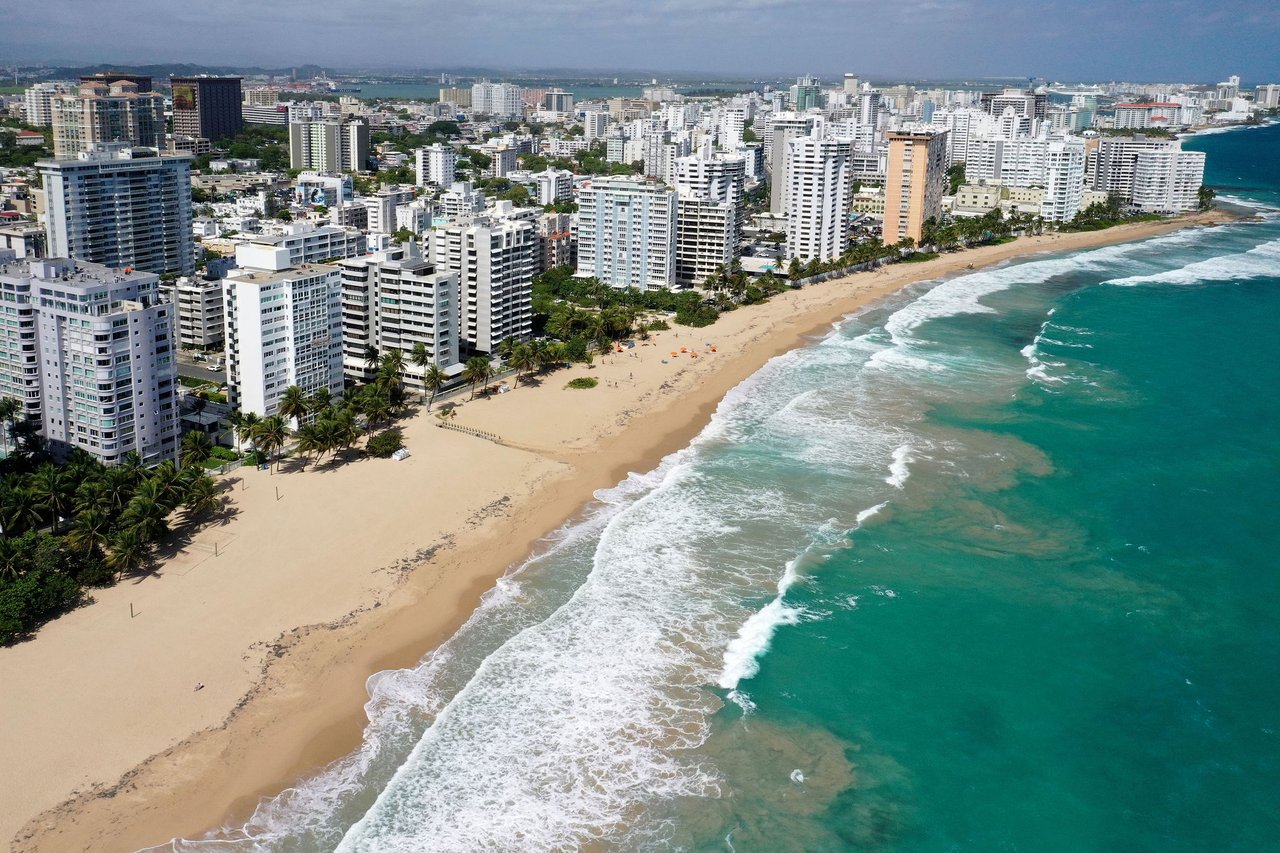
This matters because of where Isla Verde is. Carolina's municipal Code of Public Order defines the Isla Verde sector as running from the Atlantic Ocean on the north to Laguna San José and Canal Suárez on the south. Its western edge is Calle Júpiter, and on the southeast it runs from Avenida Baldorioty de Castro to the Boca de Cangrejos bridge. That puts the hotel and condo strip from the El Alambique stretch, home to the Fairmont El San Juan and the Royal Sonesta, east to Pine Grove and the Courtyard by Marriott Isla Verde Beach Resort under Carolina's jurisdiction.
West of Calle Júpiter, the Municipality of San Juan has had a short-term rental registry and annual license since Ordinance 39, Series 2022-2023, approved May 19, 2023. We looked for a comparable Carolina measure and didn't find one. Carolina's posted Code of Public Order doesn't list a dedicated short-term rental licensing chapter in its index. The Finance Department handles municipal patente filings, but its page doesn't describe any requirement specific to short-term rentals. Not finding an ordinance doesn't prove one doesn't exist, and a buyer should confirm directly with the municipality.
Comparing the two municipalities shows where the condo documents come in:
| Layer | San Juan side of Calle Júpiter | Isla Verde, Carolina side |
|---|---|---|
| State innkeeper registration and 7% room tax for stays under 90 days (per Puerto Rico Tourism Company's guidance) | Applies | Applies |
| Municipal short-term rental license | Annual license under Ordinance 39 | No comparable ordinance located in our research |
| Sworn statement of compliance with master deed and bylaws | The Municipality of San Juan requires it for the city license | No municipal filing located; the bylaws still govern |
| Council of Owners' power to set or lift a prohibition | Applies under Ley 129-2020 | Applies under Ley 129-2020 |
San Juan's license requirements include a sworn statement that the property complies with the restrictive conditions, master deed and bylaws where the rental will operate, and the municipality may verify it. The same list requires evidence of Tourism Company and Treasury compliance, a CRIM no-debt certificate or a current payment plan, and a municipal patente where applicable. So in San Juan, the city checks your compliance with the bylaws when you apply. In Isla Verde, we found no municipal step that does this. The bylaws still apply, and any problem is more likely to come up through the building itself than through a city application.
The state layer that applies everywhere
The statewide rules apply on both sides of Calle Júpiter. The Puerto Rico Tourism Company's guidance says rentals of studios, apartments, homes and villas for stays under 90 consecutive days must register as an innkeeper, collect the 7% room occupancy tax on the room rate, and remit it to the Tourism Company under Act 272 of September 9, 2003. Declarations are due monthly by the 10th of the following month. The agency says violations can bring fines of $500 per day, up to $25,000, on top of other penalties or interest. The details are on the Tourism Company's room tax page.
None of these state requirements address whether your building allows short-term rentals. A unit can be fully registered with the Tourism Company and still be in a building whose bylaws set a minimum lease term.
What changed this summer in condo disputes
If a short-term rental question ends up in a dispute, the process changed in 2026. Act 157-2026, signed July 31, 2026, amended several articles of Ley 129-2020. Among its central changes are new rules on jurisdiction for condominium disputes and specialized court rooms to hear them. It also amended Article 52, which covers objections to condominium agreements that require unanimity or a two-thirds vote. An objection now has to state its grounds. An unfounded objection is treated as not made and can be challenged in court.
Our research didn't establish which vote threshold applies to a short-term rental amendment in a particular building, and neither Act 13 nor Act 157 changed the Condominium Act's short-term rental provision. What Act 157 does change is how much weight a single owner's unexplained "no" carries on votes that fall under Article 52. Ask a Puerto Rico attorney to read your building's documents against the current statute before you rely on any vote outcome.
A statewide bill that would reach Carolina
One pending bill could add a municipal layer in Isla Verde. Senate Bill 238, by Senator Nitza Morán Trinidad, would create a uniform licensing system and mandatory municipal registries in all 78 municipalities, Carolina included. Hosts would record tax, permit and guest-capacity information. The bill would also move 1 percentage point of the existing 7% lodging tax directly to municipalities. The Senate approved it on November 13, 2025, and Metro reported it would go to the House of Representatives in the next session. Our research couldn't confirm House passage or a governor's signature as of October 2026, so treat it as a proposal. As reported in 2025, the bill would also keep stricter condo rules that prohibit short-term rentals in place. So even if it becomes law, a building's bylaws would still decide.
Before you sign on an Isla Verde unit
- Request the bylaws under Act 13 as soon as you're seriously considering the unit, and note the date. The administrator has 5 business days.
- Read the master deed and bylaws for any minimum lease term. Under Ley 129-2020, that clause is what makes a prohibition possible.
- Look for operating rules the Council of Owners has adopted for short-term stays, such as registration with management or limits on common-area use.
- Use the board contacts the administrator has to provide, and ask whether a short-term rental amendment is on any upcoming agenda.
- Confirm the seller's Tourism Company innkeeper registration if the unit is being sold as an operating rental, and plan your own registration if you'll be the operator.
- Check with the Municipality of Carolina whether any local registration or patente applies to your planned use.
A few questions that come up often
Does Act 13 apply to every condo in Isla Verde? It amends Article 13 of Ley 129-2020, which covers properties under the horizontal property regime. Any Isla Verde building organized as a condominium under that law falls within it.
Can a building ban short-term rentals after I buy? Under Ley 129-2020, the Council of Owners can amend the master deed or bylaws at any time to establish, modify or eliminate a short-term rental prohibition. How that affects an existing operator depends on the amendment and the building's documents, which is a question for legal counsel.
Does a 30-night stay count as short-term? Both the Condominium Act and the Tourism Company use under 90 consecutive days as the cutoff, so a 30-night stay falls inside it. That matters for anyone planning furnished stays for corporate tenants or relocating professionals.
Before you make an offer, Gigi Realty PR can request the building's bylaws on your behalf, go through them with you for any minimum lease term, and model the unit's rental yield under both short-term and longer-lease scenarios, so your offer reflects what the building actually allows. Request your personalized market valuation, and we'll start with the documents.
This article is general information, not legal, tax or financial advice. Consult a qualified professional about your situation.